WASHINGTON, D.C. — U.S. Senator Katie Britt (R-Ala.) joined an Appropriations Subcommittee on Labor, Health, Human Services, Education, and Related Agencies hearing to review the Fiscal Year (FY) 2027 Budget for the National Institutes of Health. Senator Britt spoke with Jay Bhattacharya, M.D., Ph.D., Director of the National Institutes of Health (NIH), Dr. Joni Rutter, Ph.D., Director of the National Center for Advancing Translational Sciences, and Dr. Nora Volkow, M.D., Director of the National Institute on Drug Abuse.
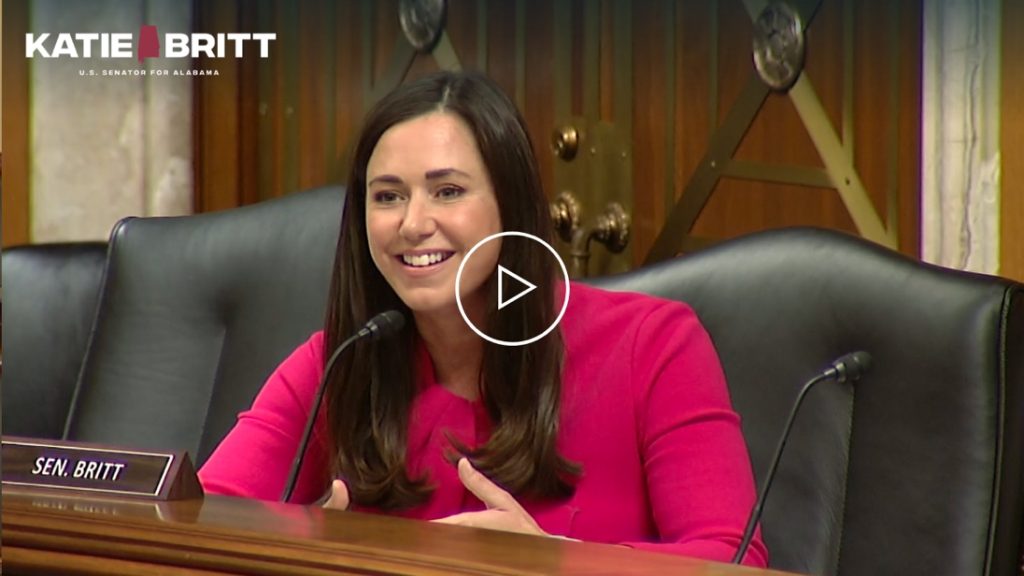
Senator Britt began by thanking NIH Director Bhattacharya, saying, “Dr. Bhattacharya, thank you so much for your commitment to ensuring that life-saving and life-changing research continues and is seen through to fruition. I know this entire group is responsible for that. You are giving people hope and giving people an opportunity to live another day. And I just want to tell you how grateful I am for that, and what an honor it is to stand alongside you in that.”
Senator Britt’s first line of questioning highlighted research from the National Institute of Drug Abuse on gambling addictions: “When we’re looking at addiction and we’re looking at different abuses, your research has really been groundbreaking. One of your areas of study is actually gambling addiction, and we are seeing that run rampant. You could ask any 15 through 30-year-old about people gambling and the prevalence of that addiction amongst their peers and you will be startled by what you hear. Can you talk to me a little bit about what we know about gambling disorder, and what characteristics make some groups uniquely vulnerable to this addiction?”
Dr. Volkow responded, stating, “In terms who are the highest risk is teenagers, the transition from teenagers to young adults … and what we are seeing is a significant rise in gambling, whether it is through sports or other means among young population as well as in adults. And so, if you look at it from our understanding from the biology, we know that the circuits involved with addictive behaviors to drugs actually overlap with those. That leads to compulsive use of behaviors like gambling. We’re also very interested in determining if there are … interventions that we are using for addictive drugs can have beneficial effects for gambling addiction…. But I do think it is crucial that … we mount prevention interventions that can protect children and adolescents from gambling disorders.”
Senator Britt highlighted the GAME Act, which she introduced this week to prevent minors from being targeted by gambling advertisements: “Senator Blumenthal and I dropped the GAME Act this week where it bans digital marketing to teenagers (and) to underage individuals for gaming … We think that that could make a significant difference if they’re not being driven that marketing … But yet Congress continues to be feckless when it comes to actually dealing with what’s happening with our young people, with social media, with putting up proper guardrails and protecting them from these types of advertisements … And so, I hope that people will take a look at your research, and that we will do our job and protect the most vulnerable, which is our children.”
In her final line of questioning, Senator Britt focused on rural health care, asking, “We talked about clinical trials … It’s important that those occur, and it’s important that those are accessible to every single individual, regardless of their zip code. So, I’d also like to know what NIH is doing to make that more obtainable in places that are sometimes unreached.”
Dr. Rutter discussed several programs supporting rural research: “In terms of rural research … with a large clinical and translational science awards program we work with the IDEA state programs, and we work with other hubs and spokes that the CTSAs also award. And through that, we’ve developed a rural health network within that program called the Course Program. And what they do is their funding rural pilots, their funding workforce models that they can share … what they’re learning and doing, and they’re solving common barriers that exist within the rural environments. And this has been very critical to those activities. And so, in a way, the CTSA program, even though it is not necessarily in and of itself in rural environments, it is partnering with those who are and helping to disseminate the research findings to get it out into those communities, things like digital health and telemedicine, to be able to disseminate those findings more broadly.”
Senator Britt reaffirmed her support and collaboration, saying, “I’d love to continue to work with you on that.”
You can view the Senator’s full remarks here.
###